
Caring for lifer and health Making contributions to the health of human beings


Release time:2026-06-04 10:51:17 Reading:
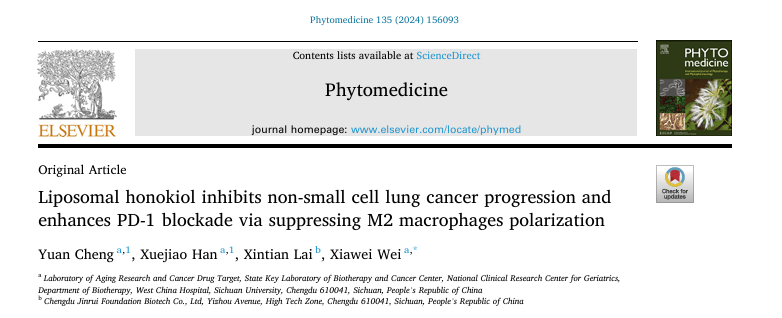
An important study titled "Liposomal Honokiol Inhibits Non-Small Cell Lung Cancer Progression and Enhances PD-1 Blockade via Suppressing M2 Macrophages Polarization" was published in the internationally renowned journal Phytomedicine in December 2024. This study reveals the significant anti-tumor effects of liposomal honokiol (JRF101/HK) in the treatment of non-small cell lung cancer (NSCLC). It demonstrates that honokiol (HK) significantly enhances the therapeutic effects of immune checkpoint inhibitors (ICIs) such as anti-PD-1 by suppressing the polarization of M2 macrophages. The research was jointly conducted by West China Hospital of Sichuan University and Chengdu Jinrui Biotech Co., Ltd., with the latter providing the honokiol liposome (JRF101/HK) reagents and research resource support.
Research Background
Honokiol is a natural compound extracted from the bark of Magnolia officinalis, and it has shown significant anti-cancer activity in various malignant tumors. While immune checkpoint inhibitors have opened new avenues for NSCLC treatment, some patients remain resistant to these therapies. This study aims to provide new combination therapy strategies to address this challenge.
Research Findings
The study assessed the effect of HK on cell proliferation and apoptosis in human lung cancer cell lines (H460 and A549) and the Lewis lung cancer mouse model (LL2), revealing that HK significantly enhances anti-tumor effects. In mouse model experiments, HK exhibited a synergistic effect when used in combination with anti-PD-1 therapy. Additionally, immunofluorescence and flow cytometry analyses showed that HK significantly reduced the infiltration of myeloid-derived suppressor cells (MDSCs) and M2 macrophages (CD206⁺), thereby enhancing anti-tumor immune responses.
The study also revealed that HK effectively inhibits the polarization of M2 macrophages by suppressing the PI3K/Akt signaling pathway, leading to a reduction in the release of immunosuppressive cytokines. This mechanistic validation provides new insights into the anti-tumor mechanisms of HK.
The research concluded that liposomal honokiol not only has substantial anti-tumor effects but can also form effective combinations with immune checkpoint inhibitors to enhance therapeutic outcomes. This provides strong scientific evidence for HK as a potential therapeutic agent in treating NSCLC and other types of cancer.
Innovative Aspects of the Research
First Revelation of HK’s Mechanism: This study is the first to reveal that liposomal honokiol (HK) enhances the efficacy of PD-1 blockade by inhibiting M2 macrophage polarization. Previous studies have focused primarily on the direct cytotoxic effects of honokiol on tumor cells. This paper clarifies its immune modulation mechanism by preventing tumor-associated macrophages (TAMs) from polarizing into immune-suppressive M2 types, thereby remodeling the tumor microenvironment (TME).
Proposed Tripartite Strategy: The study proposes a three-pronged strategy combining “active components of traditional Chinese medicine + liposomal delivery + immune checkpoint inhibitors.” This innovative combination integrates traditional herbal constituents (honokiol) with modern liposomal nanotechnology and PD-1 monoclonal antibodies, providing a new approach to overcome resistance in immunotherapy, especially in NSCLC, which has not been reported previously.
In-depth Mechanistic Exploration: The study elucidates the involvement of the STAT6 signaling pathway, demonstrating that HK selectively regulates M2 polarization by inhibiting STAT6 phosphorylation, rather than directly impacting M1 polarization. This reflects a clear and targeted mechanism.
Significance of the Research
Addressing Clinical Challenges: The study aims to improve the low response rates of PD-1/PD-L1 inhibitors in NSCLC. Immunotherapy resistance is closely associated with the abundance of M2-type TAMs. This research proposes a highly translatable combination therapy that could convert “cold tumors” into “hot tumors” and enhance PD-1 efficacy.
Clinical Translation of Honokiol: Due to honokiol’s poor solubility and low bioavailability, its application has been limited. The liposomal formulation overcomes its delivery challenges and expands its potential applications from traditional anti-inflammatory and antioxidant properties to tumor immunotherapy.
Alignment with Modernization of Traditional Chinese Medicine and Nano-Immunotherapy: The study offers a paradigmatic approach for designing natural product-based immunomodulators, thus possessing high scientific value and potential clinical application prospects.
Outlook for the Future
Chengdu Jinrui Biotech Group will continue to advance the clinical research of its injectable honokiol liposome (JRF101/HK). This globally pioneering liposome product is specifically designed for patients with recurrent glioblastoma (GBM) post bevacizumab (BEV) treatment and has shown significant clinical efficacy and good safety, with a survival period notably superior to traditional treatment options, indicating market potential.
To broaden the indications of JRF101, the company will focus on exploring its use in combination with immune checkpoint inhibitors for the treatment of non-small cell lung cancer and other solid tumors, investigating its anti-tumor mechanisms, particularly in regulating the tumor immune microenvironment. The aim is to expedite the market launch of this innovative drug to benefit a wide range of cancer patients.
Additionally, the company will continue to increase investment in innovative drug research and the modernization of traditional Chinese medicine, leveraging its liposomal delivery technology platform and natural product anti-tumor research strengths to promote the development of more innovative drugs with independent intellectual property rights, providing safe, effective, and accessible Chinese-origin treatment options for cancer patients worldwide.
Refer to the literature for details:
